Showing posts with label creativity. Show all posts

30/04/2013

The Hunt for the Creative Individual

Creativity can quite simply be defined as the capacity to come up with new ideas to serve a purpose. Creativity is thus one of the most important sources of renewal. Creativity contributes to innovation and improvements in working life, commerce and industry.
No wonder employers want creative employees in areas where it is essential to come up with proposals for new products and services, and new ways of doing things.

The creative personality
Professor Øyvind L. Martinsen at BI Norwegian Business School has conducted a study to develop a personality profile for creative people: Which personality traits characterise creative people?
The study was conducted with 481 people with different backgrounds. The segment consists of various groups of more or less creative people.
The first group of creative people consists of 69 artists working as actors or musicians in a well-known symphony orchestra or are members of an artist's organisation with admission requirements.
The second group of creative people consists of 48 students of marketing.
The remaining participants in the study are managers, lecturers and students in programmes that are less associated with creativity than marketing.
The creativity researcher mapped the participants' personality traits and tested their creative abilities and skills through various types of tasks.
Seven creativity characteristics
In his study Martinsen identifies seven paramount personality traits that characterise creative people:
  1. Associative orientation: Imaginative, playful, have a wealth of ideas, ability to be committed, sliding transitions between fact and fiction.
  2. Need for originality: Resists rules and conventions. Have a rebellious attitude due to a need to do things no one else does.
  3. Motivation: Have a need to perform, goal-oriented, innovative attitude, stamina to tackle difficult issues.
  4. Ambition: Have a need to be influential, attract attention and recognition.
  5. Flexibility: Have the ability to see different aspects of issues and come up with optional solutions.
  6. Low emotional stability: Have a tendency to experience negative emotions, greater fluctuations in moods and emotional state, failing self-confidence.
  7. Low sociability: Have a tendency not to be very considerate, are obstinate and find faults and flaws in ideas and people.
Among the seven personality traits, associative orientation and flexibility are the factors that to the greatest extent lead to creative thinking.
"Associative orientation is linked to ingenuity. Flexibility is linked to insight," says the professor. The other five characteristics describe emotional inclinations and motivational factors that influence creativity or spark an interest in creativity.
"The seven personality traits influence creative performance through inter-action," Martinsen points out.

Less sociable
The study shows that the artists who participated scored much higher on associative orientation than the other participants. They have a substantial need for originality and are not particularly stable emotionally.
The personality profile of the marketing students was quite similar to the artist profile and also differs from the other participants in the study. The artists in the study also scored lower values for ambition than the others and are not particularly sociable either.
"An employer would be wise to conduct a position analysis to weigh the requirements for the ability to cooperate against the need for creativity," Martinsen believes. He also emphasises that creative people may need help to complete their projects.
"Creative people are not always equally practical and performance-oriented, which is the reverse side of the "creativity medal.

Journal Reference:
Øyvind L. Martinsen. The Creative Personality: A Synthesis and Development of the Creative Person Profile. Creativity Research Journal, 2011; 23 (3): 185 DOI: 10.1080/10400419.2011.595656

Source: ScienceDaily

21/02/2013

Link Between Creativity and Mental Illness


People in creative professions are treated more often for mental illness than the general population, there being a particularly salient connection between writing and schizophrenia. This according to researchers at Karolinska Institutet, whose large-scale Swedish registry study is the most comprehensive ever in its field.
Last year, the team showed that artists and scientists were more common amongst families where bipolar disorder and schizophrenia is present, compared to the population at large. They subsequently expanded their study to many more psychiatric diagnoses -- such as schizoaffective disorder, depression, anxiety syndrome, alcohol abuse, drug abuse, autism, ADHD, anorexia nervosa and suicide -- and to include people in outpatient care rather than exclusively hospital patients.
The present study tracked almost 1.2 million patients and their relatives, identified down to second-cousin level. Since all were matched with healthy controls, the study incorporated much of the Swedish population from the most recent decades. All data was anonymized and cannot be linked to any individuals.
The results confirmed those of their previous study, that certain mental illness -- bipolar disorder -- is more prevalent in the entire group of people with artistic or scientific professions, such as dancers, researchers, photographers and authors. Authors also specifically were more common among most of the other psychiatric diseases (including schizophrenia, depression, anxiety syndrome and substance abuse) and were almost 50 per cent more likely to commit suicide than the general population.
Further, the researchers observed that creative professions were more common in the relatives of patients with schizophrenia, bipolar disorder, anorexia nervosa and, to some extent, autism. According to Simon Kyaga, Consultant in psychiatry and Doctoral Student at the Department of Medical Epidemiology and Biostatistics, the results give cause to reconsider approaches to mental illness.
"If one takes the view that certain phenomena associated with the patient's illness are beneficial, it opens the way for a new approach to treatment," he says. "In that case, the doctor and patient must come to an agreement on what is to be treated, and at what cost. In psychiatry and medicine generally there has been a tradition to see the disease in black-and-white terms and to endeavour to treat the patient by removing everything regarded as morbid."
The study was financed with grants from the Swedish Research Council, the Swedish Psychiatry Foundation, the Bror Gadelius Foundation, the Stockholm Centre for Psychiatric Research and the Swedish Council for Working Life and Social Research.

Journal Reference:
Simon Kyaga, Mikael Landén, Marcus Boman, Christina M. Hultman, Niklas Långström, Paul Lichtenstein. Mental illness, suicide and creativity: 40-Year prospective total population study. Journal of Psychiatric Research, 2012.

Source: ScienceDaily.com 

17/09/2012

Preparing for the meeting in Rome, 3-7 October 2012

Giovanni Paolo Pannini "Capriccio panoramico di Roma con il Colosseo,l'Arco di Costantino e il Tempio di Castore e Polluce"

Canaletto "Veduta di Piazza Navona, Roma"

William Turner "Modern Rome - Campo Vaccino"

  Ettore Roesler Franz "Ponte rotto"

17/07/2012

Meeting in Siauliai, June 2012

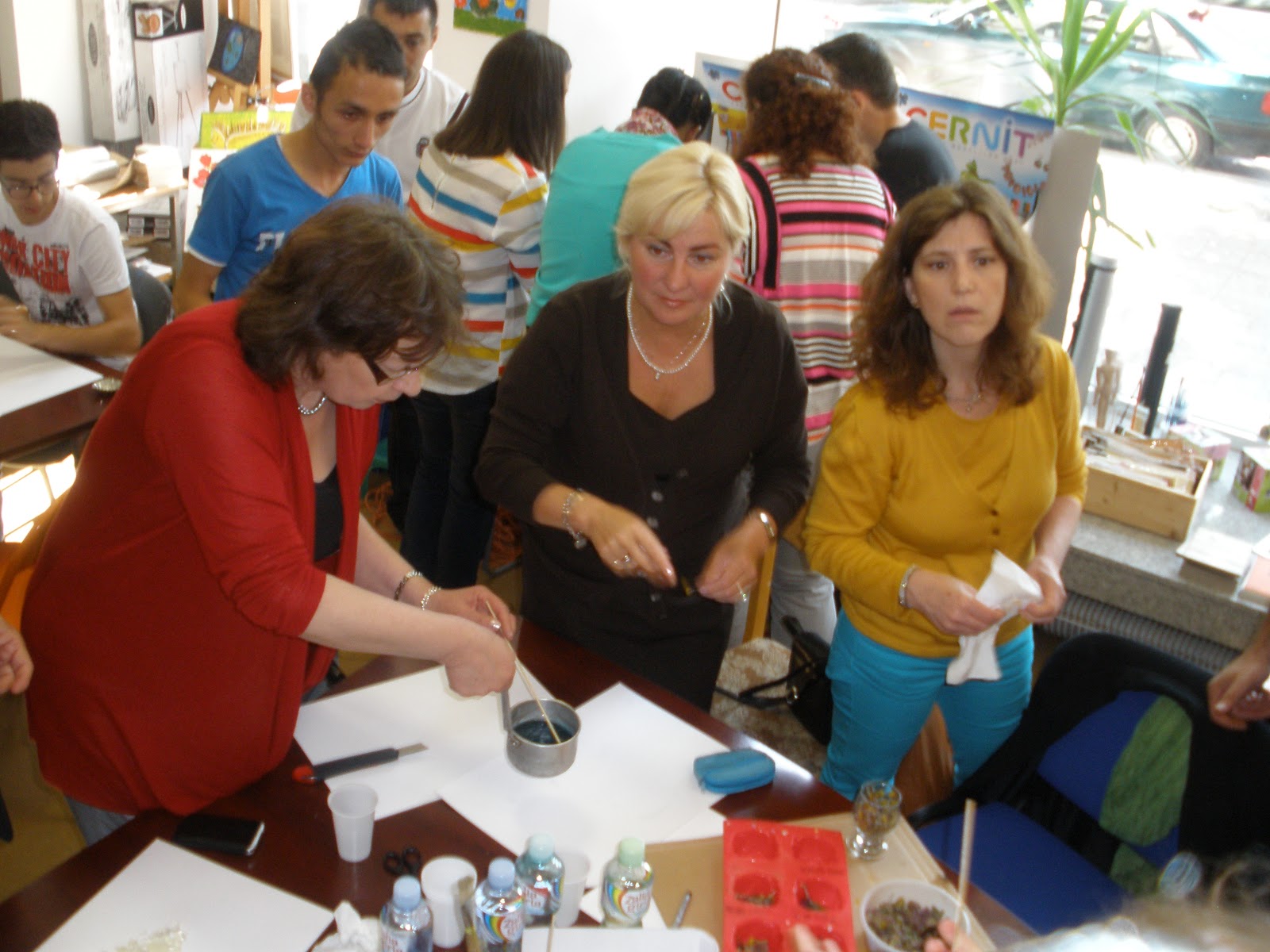
The third meeting of Evalt project has been held in Siauliai from 6 to 10 of June 2012. The agenda foresaw moments of discussion - in order to monitor what has been accomplished until now and to agree the next actions to take - and two workshop on expressive arts (decoupage and painting) and crafts (making soaps, bread, etc.) as tools for education of disadvantaged adults.

 The group at the opening moment of the meeting

The workshop on expressive arts: in blue jersey, the trainer

Liuda Radzeviciene (in red) and Lina Miliuniene (in black) of the Lithuanian team, coordinator of the meeting

Moments of the workshop

 Moments of the workshop

16/07/2012

Developing the Innovative Mind

From 20 to 23 September 2012, in Coronado, CA (San Diego), Marriott Coronado Island, the 2012 EdTA Annual Conference will take place. The Educational Theatre Association (EdTA) is a national nonprofit organization (with approximately 90,000 student and professional members) whose mission is shaping lives through theatre education.


The 4Cs of creativity, critical thinking, collaboration, and communication are the cornerstone 21st century skills that every college- and career-ready student needs to possess. A professional theatre educator has the "job" to cultivate and model these lifelong traits. To do so, he/she must be innovative, in the classroom and on the stage. In the 2012 EdTA Conference it will be explored the broad challenges that today’s theatre teacher educator must meet in order to succeed in our ever-changing world.
 
Conference 2012 will feature:
• Opening keynote speaker, Ben Cameron, known for his dynamic and compelling presentations on the value of the arts.
• Presentation of findings from the first national landscape study in more than twenty years of theatre teachers and school administrators on the state of theatre education, conducted by EdTA and Utah State University.
• Overview of the Next Generation Arts Standards Project.
• Practical workshops and educational opportunities to augment educator's skills for the classroom.
• Opportunities to network and exchange ideas with other educators. 
• Inspiration from the newest class of EdTA Hall of Fame inductees.
 
To see what else the conference has to offer or to find out more about the host city, explore the link: http://schooltheatre.org/events/edta-conference/
 

23/04/2012

Metaskills: bringing learnt skills to life


What about Skills?

Skills are specific things we know how to do, like how to make origami, how to weave, how to paint, and so on. They are generally things you learn by doing, rather than by reading about in abstract. Sure, you can gain knowledge about them by reading general theory, but you have to actually get your hands dirty to get any level of mastery at all. The more skills you have, the more intelligent you become: the subconscious mind is always searching for patterns and analogies, and the more skills you have, the more sources there are for the subconscious mind to find these things. Thus, proficiency in one skill lends itself to solving unexpected problems, sometimes even without our being explicitly aware of it.

Metaskills are abstract skills which have to do with other skills. For example, an autodidact is a person who has the metaskill of being able to self-teach him or herself new skills without an outside teacher. A teacher is a person who has the metatalent to teach skills to others; here I speak of someone who is a teacher of a wide variety of things, not necessarily a teacher who focuses on one single topic. Teaching one single topic, like calculus, is a skill, but the ability to learn an arbitrary skill and then teach it to others, that is a meta-skill. Generalization is a metaskill where you look at a wide variety of skills and figure out the common underlying patterns. Specialization is one where you can take a skill and focus it more precisely, to get a new skill which is a special case of the broader original skill.

Skills Training and Metaskills Training

Skills training involves performing a skill over and over. As you perform a skill, your subconscious mind constantly tries to figure out how it can help you. At first, it doesn’t know how to help you at all, and you have to consciously think about every littlest detail. In time, the subconscious takes over more and more of the workload, allowing you to perform the skill with less and less conscious attention. This is sometimes referred to as muscle memory; you can do the skill without even thinking about it. To get to this point, you have to perform the skill quite a bit. Each time, it comes a little easier. Once your subconscious has completely taken over the performance of the skill, it shifts toward finding ways to optimize and improve the skill, and that’s how you evolve from a mere expert into a master.

Training a metaskill is the same. Just because a skill is meta, doesn’t make it any different from any other skill. The difference is that we don’t usually consciously train our meta-skills because most people don’t even recognize them as skills. Besides that, training a meta-talent is more difficult than training a skill, because you can’t as easily fall into a pattern of repetition. Whereas you can do basketball training by throwing a basketball through a hoop a whole lot of times, you can’t, for example, teach yourself calculus a whole lot of times. In order to train the meta ability of being an autodidact, you must consciously seek out new things to teach yourself. If mastering chess requires playing ten thousand games, then mastering autodidacticism requires teaching yourself ten thousand different skills.

The benefit of mastering a skill is that you get to use that one skill. It makes a contribution to your overall intelligence by giving you that much more referential material from which to draw patterns and analogies. By learning Japanese, I’ve gained the ability to talk to Japanese people in their native tongue. The benefit of mastering a metaskill is that you can get new regular skills more easily, or make better use of the regular skills you already have. When you train a skill, you are making a long term investment; when you train a meta-skill, you are making a “long long term” investment. You’re making an investment into your ability to make or profit from other long term investments.

The Reflexive Nature of Metaskills

The great thing about a meta-skill is that it’s reflexive. It’s something you apply to skills; but it is a skill, therefore, you can apply it to itself. For example, consider a master teacher who can skilfully teach every skill she possesses: in particular, she can teach how to teach. A master autodidact can, in principle, teach himself any skill: in particular, he can teach himself any metaskill. (In a very real sense, master autodidacts are like gods. They can do basically anything. I consider myself something of an intermediate level autodidact.)

Here’s another example of a metaskill. Skills analysis is the ability to take any skills you know, and break them down, analyzing them and figuring out exactly how they work. For different skills, it requires a different mastery of skills analysis to break them down. For example, just about anyone can analyze the “skill” of flipping coins. But it would take a very good skills analyst to analyze the skill of playing the harp. Skills analysis is itself just another skill, so in theory, a good enough skills analyst could break it down and analyze it.

The novel “Cheaper By The Dozen” tells the tale of the family of Frank Gilbreth, a self-described “Efficiency Expert”. He devoted his life to finding ways to make various tasks more efficient. He even invented a general system of “therbligs”, small undecomposable units of work, for analyzing general tasks. In fact, he was pioneering the “time and motion study” metaskill, which takes skills and finds ways to make them more efficient. What if someone was so good at time and motion study that they could apply it to itself, and find ways to make time and motion study itself more efficient? Then they could apply it to itself more efficiently, and make it even more efficient, and so on. How efficient could it get?

The Continuum Between Skills and Metaskills

I’ve actually been speaking of just “skills” and “meta skills” to simplify the discussion. There’s actually an entire continuous spectrum between the two. Take computer programming, for example. Programming computer games in Java is a specific skill. Programming arbitrary java applets is a slightly more meta skill, which includes the ability to program games, if you’re so inclined. Being able to program websites in arbitrary languages, learning the languages as you need ‘em, is a more meta skill. Going even more meta, you have the skill of programming any program, not just websites, in any language, learning the languages as you go.

One way to train a metaskill is to figure out the spectrum below it, and start low on the spectrum and work your way up. For example, if you want to learn to be a master teacher, you might start by simply learning how to teach your favorite subject, say, singing. Once you’re good at teaching people how to sing, you might generalize it to teaching people performance art in general. And from there, it’s not as big a jump to teaching people any arbitrary skill that you yourself possess. The master of a meta-ability probably got that way by applying the technique “by accident”, without actually being consciously aware of what was going on.

(published with kind permission of the Author, Sam Alexander, www.xamuel.com)

22/02/2012

Creative Growth through Art

Creative Growth Art Center is an organization, located in California, that serves adult artists with developmental, mental and physical disabilities, providing a professional studio environment for artistic development, gallery exhibition and representation and a social atmosphere among peers.
For more information, news, activities, artists, click here!

14/02/2012

Is there a hidden bias against creativity?

CEOs, teachers, and leaders claim they want creative ideas to solve problems. But creative ideas are rejected all the time. A new study, which will be published in an upcoming issue of Psychological Science, a journal of the Association for Psychological Science, finds that people have a hidden bias against creativity. We claim to like creativity, but when we’re feeling uncertain and anxious—just the way you might feel when you’re trying to come up with a creative solution to a problem—we cannot recognize the creative ideas we so desire.

Generally, people think creativity is good. Before starting this study, the researchers checked that with a group of college students. “Overwhelmingly, the data showed that students had positive implicit and explicit associations with creativity,” says Jennifer Mueller of the University of Pennsylvania. She carried out the new study with Shimul Melwani of the University of Pennsylvania and Jack A. Goncalo of Cornell University.

But in experiments, people’s perceptions changed. In one experiment, the researchers made some people think about uncertainty—by telling them they might get some extra money after the study based on a random lottery. Other participants went into the study without that priming. They were all given a test that shows how they group concepts together. The people who had been made to think about uncertainty were more likely to subconsciously associate words like “creative,” “inventive,” and “original” with bad concepts like “hell,” “rotten,” and “poison.” In the other condition people associated creativity words with things like “rainbow,” “cake,” and “sunshine.”

“If I ask you right now to estimate whether or not you can generate a creative idea to solve a problem, you’re not going to know,” Mueller says. That feeling of uncertainty might be the root of the problem. When you’re trying to come up with a creative solution to a problem, you worry that you can’t come up with a good idea, that what you do come up with might not be practical, or that your idea might make you look stupid. “It feels so bad sometimes trying to be creative in a social context,” Mueller says.

This uncertainty may make leaders reject creative ideas. “But sometimes we need creative ideas. If you’re a company that makes radios and suddenly nobody’s buying them anymore, you don’t have a choice,” Mueller says—you have to come up with something new. Her research suggests that rather than focusing on the process of coming up with ideas, companies may need to pay more attention to what makes them reject creative ideas.

Source: Association for Psychological Science

23/01/2012

Experiencing different cultures enhances creativity

Creativity can be enhanced by experiencing cultures different from one's own, according to a study in Personality and Social Psychology Bulletin (published by SAGE).

Three studies looked at students who had lived abroad and those who hadn't, testing them on different aspects of creativity. Relative to a control group, which hadn't experienced a different culture, participants in the different culture group provided more evidence of creativity in various standard tests of the trait. Those results suggest that multicultural learning is a critical component of the adaptation process, acting as a creativity catalyst.
The researchers believe that the key to the enhanced creativity was related to the students' open-minded approach in adapting to the new culture. In a global world, where more people are able to acquire multicultural experiences than ever before, this research indicates that living abroad can be even more beneficial than previously thought.
"Given the literature on structural changes in the brain that occur during intensive learning experiences, it would be worthwhile to explore whether neurological changes occur within the creative process during intensive foreign culture experiences," write the authors, William W. Maddux, Hajo Adam, and Adam D. Galinsky. "That can help paint a more nuanced picture of how foreign culture experiences may not only enhance creativity but also, perhaps literally, as well as figuratively, broaden the mind.

Source: EurekAlert!

Complete article: When in Rome… Learn Why the Romans Do What They Do: How Multicultural Learning Experiences Facilitate Creativity